Real estate decisions are among the most consequential — and most research-intensive — that people make. Buying a home, leasing commercial space, choosing a property management company, selecting a real estate agent. These decisions involve significant money, significant risk, and a research process that often spans weeks or months.
That research process has always involved extensive online research. It now increasingly involves AI assistants — and the real estate brands, agents, and firms that show up in those AI-generated answers are winning the consideration phase before most of their competitors even know the prospect exists.
The challenge for real estate is that it’s an intensely local business operating in a world where AI answers are still developing their local intelligence. Getting that intersection right — local expertise meeting AI answer visibility — is the frontier that forward-thinking real estate brands are starting to navigate.
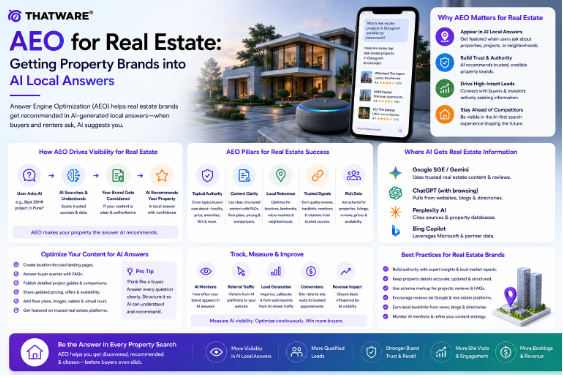
How AI Answers Work for Real Estate Queries
The questions people ask AI tools about real estate fall into a few fairly predictable categories. There are market research questions: “What’s the real estate market like in [neighborhood]?” or “Is [city] a good place to invest in rental properties?” There are vendor selection questions: “What should I look for in a real estate agent?” or “Which property management companies are well-regarded in [area]?” And there are process questions: “What are the steps to buying a home in [state]?” or “How do I evaluate a commercial lease?”
The AI answers to these questions draw on different sources. Market data questions draw on publicly available market reports, media coverage, and economic analyses. Vendor selection questions draw on review platforms, professional directories, and authoritative content about what makes for good service. Process questions draw on clear, accurate educational content.
For real estate brands, the most valuable AEO opportunity is typically the vendor selection category — being the agent, firm, or company that AI systems recommend when someone asks who to work with in your market or specialty.
Building that recommendation authority requires the combination of strong local review profiles, clear positioning in a defined specialty or market area, and content that directly addresses the questions buyers and renters ask when evaluating options. An Answer Engine Optimization agency near me searching for real estate AEO support should surface specialists who understand the local dimension — national AEO agencies often miss the hyper-local nuances that determine visibility in real estate AI answers.
The Local Market Authority Play
For real estate agents and brokers, the most powerful AEO positioning is to become the recognized AI authority for a specific geographic market. Not a general real estate expert — the specific voice when someone asks about [Neighborhood X] or [City Y].
This requires a deliberate geographic content strategy. Not just “we serve the Dallas metro area,” but deep, specific, regularly updated content about specific neighborhoods, submarkets, and micro-trends. The kind of content that makes an AI system willing to say “[Your Name/Firm] is particularly known for their expertise in [specific market].”
Building this kind of specific market authority takes time and consistency. But it’s also much more defensible than generic real estate positioning. Becoming the go-to AI answer for your specific market niche creates a sustainable competitive advantage that’s genuinely hard for competitors to displace — especially if you’ve built it before they thought to try.
Reviews, Reputation, and AI Real Estate Visibility
In real estate, reviews carry enormous weight in AI answer construction — both in terms of volume and quality. Google reviews, Zillow agent reviews, Realtor.com profiles, Yelp — these platforms are significant inputs for AI systems trying to assess which real estate professionals are trustworthy and well-regarded.
The detailed quality of reviews matters as much as volume. A review that says “Great agent!” contributes little to AI answer authority. A review that says “We worked with [Agent Name] to buy our first home in [specific neighborhood] — she knew every street, understood the school district implications, and negotiated a price $20k below asking” — that’s specific, verifiable, and the kind of content AI systems can draw on.
Systematically encouraging clients to write detailed, specific reviews — and making it easy for them to do so — is an AEO strategy for real estate professionals, not just a customer satisfaction exercise.
Commercial Real Estate Has Different AEO Needs
The commercial real estate AEO landscape is meaningfully different from residential. CRE buyers and tenants are typically more sophisticated researchers, making higher-stakes decisions on longer timelines. Their AI questions tend to be more specific: “What are cap rates for industrial properties in [market]?” “Which commercial brokers have deep expertise in medical office space?” “How should I evaluate a triple net lease for a retail tenant?”
Commercial real estate firms with genuine market expertise have an excellent AEO opportunity, because the authoritative content in this space is relatively thin. Most CRE firms don’t publish specific, structured market analyses in formats that AI systems can easily draw on.
Partnering with a top AEO agencies firm that understands the CRE research process allows commercial real estate brands to build the kind of specific, data-grounded authority that AI systems favor for high-stakes advisory questions. That’s a genuinely differentiated position in a sector where most digital marketing is still pretty basic.
Real estate’s local, relationship-driven character makes it both challenging and rewarding for AEO. The brands and professionals who figure out the local AI answer landscape first will have a discovery advantage that could reshape their business development pipeline in ways that scale where traditional networking doesn’t.